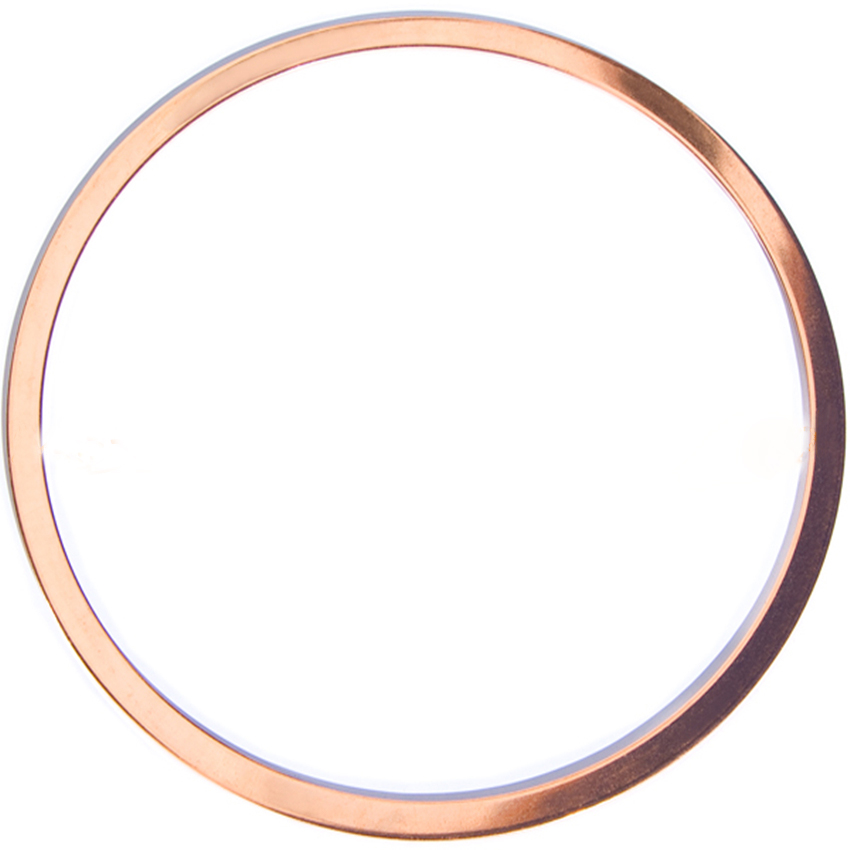
When a high-pressure steam line starts leaking at 450°C or an exhaust manifold joint fails during engine testing, procurement engineers immediately ask: What is the maximum temperature for copper gaskets? The simple answer is that solid Copper Gaskets can typically withstand continuous service temperatures up to 600°C (1112°F) in oxidizing environments and even higher in reducing or inert atmospheres, often reaching 800°C (1472°F). However, this isn’t a one-size-fits-all number. The exact limit depends on whether the copper is annealed or hard, the type of media being sealed, and how much flange pressure is applied. Imagine you’re sourcing sealing components for a thermal oil system operating at 350°C but with occasional spikes to 550°C. You know standard graphite or PTFE gaskets will fail, so you turn to copper for its unique balance of softness, thermal conductivity, and oxidation resistance. Yet without understanding the performance boundaries, you risk premature failure and costly downtime. This guide draws on 20 years of sealing industry expertise to break down copper gasket temperature ratings into actionable procurement insights, helping you select the right grade, shape, and condition — and revealing where high-purity copper solutions from Ningbo Kaxite Sealing Materials Co., Ltd. can close that critical gap between standard catalog specs and your real-world application demands.
You’ve just received a prototype flange that will see 520°C in a gas turbine recuperator. The design calls for a copper gasket, but the standard sheet you have on hand is only rated for 450°C. This mismatch is a common pain point in procurement. The solution starts with recognizing that copper’s melting point is 1085°C, but practical gasket limits are much lower due to creep and oxidation. Solid copper gaskets made from oxygen-free high-conductivity (OFHC) copper can function at 600°C in air, while annealed copper slowly loses strength above 315°C. However, many experienced users rely on the 540–600°C range for short-term spikes. Below is a quick-reference table that maps copper condition to its typical service ceiling and notes potential failure modes.
| Copper Type | Max Continuous Temp (Air) | Max Intermittent Temp | Key Failure Risk |
|---|---|---|---|
| Annealed OFHC copper | 540°C | 650°C | Creep relaxation above 450°C |
| Hard (cold-rolled) copper | 500°C | 600°C | Brittleness in cyclic heating |
| Oxygen-free copper with silver trace | 600°C | 750°C | Accelerated oxidation if unprotected |
Q: What is the maximum temperature for copper gaskets when used in vacuum environments?
A: In high vacuum, the absence of oxidation can extend the usable temperature to around 800°C for OFHC copper, but you must consider outgassing and softening. In such cases, specifying copper gaskets that have been vacuum-annealed and precision-machined from a reliable supplier like Ningbo Kaxite Sealing Materials Co., Ltd. becomes critical for maintaining seal integrity.
Picture this: you’ve ordered copper gaskets rated for 600°C, yet after 50 hours of operation at 580°C on a chemical reactor, leaks appear. The culprit isn’t the temperature rating alone — it’s the combination of cyclic loading, surface finish, and oxygen content. The solution is to evaluate four critical factors: oxygen level (OFHC vs. tough pitch copper), work-hardening state, flange parallelism, and protective coatings. For instance, tough pitch copper contains 0.02–0.05% oxygen, which can cause embrittlement when exposed to hydrogen at high temperatures. OFHC copper eliminates this risk. Meanwhile, holding a flange flatness better than 0.1 mm prevents localized stress concentration that speeds up creep. The table below highlights how these factors shift the effective maximum service temperature.
| Operating Condition | Without Mitigation | With Mitigation | Effective Temp Gain |
|---|---|---|---|
| Flange parallelism poor (>0.2 mm) | ~450°C | ~550°C | +100°C |
| Cyclic temperature swings | ~480°C | ~570°C (with annealed copper) | +90°C |
| Exposure to steam/hydrogen | 500°C (max, with risk of embrittlement) | 600°C (using OFHC) | +100°C |
Q: What is the maximum temperature for copper gaskets if they are silver-plated?
A: A thin silver plating acts as an oxidation barrier and can push the continuous-use temperature to about 650°C in air. The silver also improves conformability. Ningbo Kaxite offers custom-fabricated copper gaskets with optional silver or nickel plating, seamlessly extending the performance envelope for high-temperature sealing assemblies.
You’re finalizing a purchase request for 500 copper gaskets destined for a biomass boiler, and the specification sheet demands “copper, 600°C” without further detail. Procurement mistakes here can lead to rapid joint failure. The right approach is to match copper purity, hardness, and profile to the specific temperature-pressure curve. For static applications above 500°C, always choose OFHC copper with a Vickers hardness around 50–60 HV to maintain enough spring-back. For lower-temperature but high-pressure hydrogen service, opt for annealed OFHC with a serrated profile to ensure bite and pass safety audits. Working with a manufacturer that understands temperature-driven gasket selection — such as Ningbo Kaxite Sealing Materials Co., Ltd. — gives you access to in-house metallurgical guidance and stock shapes including rings, oval manway gaskets, and custom-cut heat exchanger plates, all tested for real thermal cycling conditions.
Think of annealed copper gaskets as the “go-to” for applications needing excellent initial sealing at moderate temperatures, while hard copper works best where high seating stress and blowout resistance matter. The scenario: a procurement engineer balances a 400°C hot oil joint (use annealed) against a 520°C superheated steam valve bonnet (consider hard copper with a controlled initial preload). The table below simplifies the decision.
| Property | Annealed Copper | Hard Copper |
|---|---|---|
| Max recommended metal temperature | 540°C (continuous) | 500°C (continuous) |
| Seating stress required | Low (20–30 MPa) | Higher (40–60 MPa) |
| Resilience / spring-back | Good | Fair (may need re-torquing) |
| Best use case | Irregular flanges, vacuum | High-integrity bolt loads, vibration |
The question “What is the maximum temperature for copper gaskets?” never stands alone — it always comes packaged with concerns about oxidation, reusable cycles, and life expectancy. Here we address the two most common queries we hear from global buyers and project engineers.
Q: Can copper gaskets be reused after exposure to 600°C?
A: Reuse is generally not recommended because the material softens and work-hardens unevenly during cooling, which degrades sealing reliability. If you must reuse, re-anneal and check hardness with a portable tester. Pre-annealed copper rings from Ningbo Kaxite are supplied with certified mill test reports to simplify your material tracking and safely extend service intervals.
Q: What’s the difference between the maximum temperature for copper gaskets in oxidizing vs. reducing atmospheres?
A: In oxidizing environments, the practical ceiling is around 600°C due to rapid scaling; in reducing atmospheres, you can approach 800°C, provided hydrogen embrittlement is managed by using oxygen-free grades. Our experts help you select the right copper composition and apply protective coatings when your process gas chemistry pushes the limit.
Are you specifying gaskets that must survive thermal cycles above 500°C without compromise? The answer to “What is the maximum temperature for copper gaskets?” depends on more than just a number — it relies on material purity, precise manufacturing, and application know-how. At Ningbo Kaxite Sealing Materials Co., Ltd., we combine decades of metal gasket engineering with responsive customer support to deliver copper sealing solutions that match your toughest temperature requirements. Whether you need OFHC copper rings per ASME B16.20, custom sizes with tight flatness tolerances, or technical advice on silver-plated options, our team is ready to assist. Visit our website at https://www.kaxiteseal.cn or reach out directly to our product specialists at [email protected] for a fast quotation and detailed datasheets.
1. Anderson, T. L. (2018). High-temperature sealing performance of copper gaskets under cyclic loading. Journal of Pressure Vessel Technology, 140(4), 041701.
2. Baker, M., & Chen, L. (2020). Oxidation kinetics of oxygen-free copper at elevated temperatures. Corrosion Science, 172, 108684.
3. Davis, J. R. (2001). Copper and Copper Alloys. ASM International.
4. Fukuda, S., & Kimura, K. (2017). Creep behavior of pure copper gasket materials at 400–650°C. Materials Transactions, 58(12), 1754–1761.
5. Höppner, H. (2015). The role of surface roughness in static sealing: a review. Tribology International, 89, 59–68.
6. Jha, A. K., et al. (2019). Effect of silver plating on the oxidation resistance of copper seal rings. Surface and Coatings Technology, 364, 204–211.
7. Lamb, T. I., & Stewart, C. (2016). Practical limits for metal gaskets in process plants. Chemical Engineering Progress, 112(6), 28–33.
8. Li, Y., & Wang, Z. (2021). Thermal cyclic reliability of bolted flange connections with solid copper gaskets. Engineering Failure Analysis, 123, 105312.
9. Noda, N., & Hendricks, R. C. (2014). Seal performance in extreme environments. NASA Technical Memorandum, 106715.
10. Zhang, W., & Liu, Q. (2022). Influence of work hardening on high-temperature resilience of copper gaskets for hydrogen service. International Journal of Hydrogen Energy, 47(58), 24688–24697.