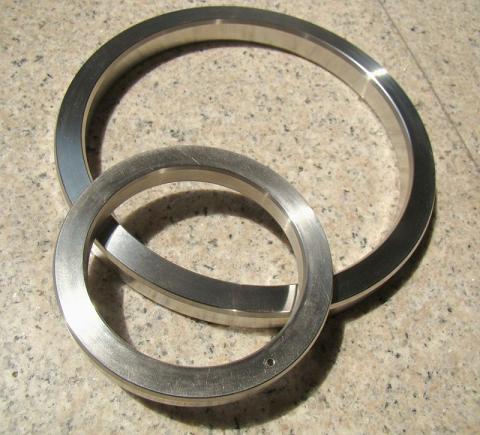
Imagine standing on an offshore platform in the North Sea, where a single seal failure could shut down operations costing $3 million daily. You’re holding three metallic rings, each stamped with a cryptic code: R, RX, BX. Your procurement sheet lists API 6A requirements, but the vendor’s catalog blurs into a technical fog. What is the difference between R, RX, and BX ring joint gaskets? These aren’t just letters—they dictate whether your wellhead survives 20,000 psi or leaks catastrophically. R type gaskets, the octagonal or oval workhorses, handle standard API 6B flanges up to 6,250 psi with simple bolt tensioning. RX type steps into the deep end, designed for API 6BX flanges and extreme pressure scenarios, featuring a pressure-energized profile where internal forces boost the seal tightness. BX type is the precision specialist, fitting specific 6BX flanges with a pitch diameter contact that tolerates no misalignment. Choosing wrong means reordering, downtime, and safety risks. At Ningbo Kaxite Sealing Materials Co., Ltd., I’ve spent two decades turning this alphabet soup into leak-free installations for global procurement teams. Let’s decode the puzzle so you never second-guess a spec sheet again.
Pain Point Scenario: A procurement engineer reviews two quotes for API 6BX flanges—one supplier offers R type gaskets at 40% lower cost, another insists on BX type. The engineer picks the cheaper option, only to discover during hydrotesting that the R gasket cannot maintain seal integrity beyond 10,000 psi. The wellhead gets flagged, and the rig loses two weeks of production.
Solution: R type gaskets are suitable for API 6B flanges with pressure ratings up to 6,250 psi (occasionally 10,000 psi in limited configurations). RX type gaskets are designed for API 6BX flanges with pressure ratings from 5,000 to 20,000 psi, utilizing a self-sealing mechanism where internal pressure energizes the gasket against the flange groove. BX type gaskets operate exclusively in API 6BX flanges, with a critical pitch diameter contact that seals at pressures up to 20,000 psi, demanding precise machining tolerances.
| Parameter | R Type | RX Type | BX Type |
|---|---|---|---|
| Applicable Flange Standard | API 6B | API 6BX | API 6BX |
| Pressure Rating Range | 3,000 – 6,250 psi | 5,000 – 20,000 psi | 10,000 – 20,000 psi |
| Seal Mechanism | Mechanical compression | Pressure-energized | Pitch diameter contact + metal-to-metal |
| Interchangeability | Not interchangeable with RX/BX | Not interchangeable with R/BX | Requires matched flange pairing |
Pain Point Scenario: A gas processing plant in Texas orders BX gaskets for a routine flange replacement, but the field technician discovers the existing flanges are API 6B type, which only accepts R gaskets. The $18,000 order becomes dead inventory, and the plant manager escalates the procurement error to the C-suite.
Solution: R type Ring Joint Gaskets are the backbone of conventional wellheads, choke manifolds, and pipeline flanges operating under moderate pressure conditions. Their octagonal cross-section provides reliable initial seal integrity through bolt preload, making them ideal for onshore processing facilities and shallow-water platforms. RX type gaskets excel in deepwater wellheads, subsea trees, and high-pressure christmas tree assemblies where 15,000+ psi ratings demand a dynamic seal that intensifies under system pressure. BX type gaskets are reserved for critical choke and kill lines, compact flanges, and space-constrained BOP stack connections where precision alignment and zero-leakage performance are non-negotiable. Choosing correctly hinges on verifying the flange standard stamped on the equipment ring groove—API 6B calls for R, while API 6BX with pressure-energized needs dictate RX or BX.
R type gaskets rely solely on the mechanical force from flange bolts to create a seal. RX type gaskets feature a crinkle-faced geometry that allows internal pressure to push the gasket outward against the groove walls, strengthening the seal as pressure rises. BX type gaskets use a pitch diameter interference fit where the gasket's mid-section contacts the flange groove at a controlled interference, achieving a metal-to-metal seal that becomes tighter under system pressure without excessive bolt load. This distinction directly impacts safety margins in high-pressure gas service—a misapplied R gasket in a 15,000 psi Christmas tree riser has no pressure-energization capability and will leak once internal pressure exceeds bolt preload compression.
Pain Point Scenario: A warehouse manager receives a mixed pallet of ring joint gaskets with smeared markings. The packing slip lists R-24, RX-39, and BX-154, but the physical rings look nearly identical in size. The manager guesses, ships an RX gasket to a BX-spec site, and the installation crew discovers the mismatch only after torquing.
Solution: R type gaskets are marked with an "R" prefix followed by a number (e.g., R-24), and their cross-section is either oval or octagonal. RX type gaskets carry "RX" prefix numbers (e.g., RX-39) and feature a distinct groove on the outer diameter allowing fluid bypass during makeup. BX type gaskets use "BX" prefix numbering (e.g., BX-154) and possess a square cross-section with radius corners, always including a pressure passage hole. Never rely on visual similarity—check the permanent laser marking on the gasket outer face, cross-reference with the flange ring groove number stamped on the equipment, and verify the hardness value (typically HRB 68 to HRC 22 depending on material specification). Ningbo Kaxite Sealing Materials Co., Ltd. laser-engraves every gasket with traceable heat numbers and material grades, eliminating identification guesswork for warehouse teams.
Pain Point Scenario: A purchasing team sources BX-155 gaskets from an unverified supplier offering soft iron with a 3.1 certification. The gaskets pass incoming QA checks based on hardness testing but fail during service when H2S sour gas causes sulfide stress cracking because the material lacked NACE MR0175 compliance documentation.
Solution: Always specify the material grade in purchase orders beyond just "soft iron" or "F5." For sour service, demand compliance with NACE MR0175/ISO 15156 and request a full material test report (MTR) showing yield strength, hardness, and chemical composition. R, RX, and BX gaskets each have unique hardness requirements based on their seal mechanics—RX gaskets for subsea applications often require Inconel 825 overlay or solid Alloy 625 to combat corrosion. BX gaskets handling 20,000 psi gas injection must maintain a hardness differential with the flange groove to prevent galling. At Ningbo Kaxite Sealing Materials Co., Ltd., every order ships with a digital material dossier accessible via QR code, containing PMI test results, hardness mappings, and NACE compliance certificates, so your QA team spends minutes verifying instead of days chasing paperwork.
R type gaskets are generally considered single-use because their oval or octagonal cross-section deforms plastically during initial bolt-up, losing the ability to conform to flange surface irregularities upon reuse. RX type gaskets may withstand limited reinstallation if the crinkle-faced surfaces remain undamaged and hardness readings fall within original specification, though API guidelines recommend replacement. BX type gaskets are strictly single-use due to the controlled pitch diameter interference fit; reinstallation would compromise the metal-to-metal contact geometry and risk leakage. A field reuse of a BX gasket on a gas lift compressor flange led to a methane release incident documented in an IOGP safety alert, underscoring why Ningbo Kaxite Sealing Materials Co., Ltd. advises procurement teams to treat these as one-torque components and maintain adequate spares inventory.
Pain Point Scenario: A European EPC contractor faces a 72-hour shutdown for a BX-158 gasket replacement on a critical separator flange. The local distributor stocks only R series, and air freight from Houston delays by four days due to customs. The contractor loses €2.1 million in deferred production.
Solution: Establish a vetted supplier relationship with a manufacturer capable of holding strategic inventory across all three gasket types. Ningbo Kaxite Sealing Materials Co., Ltd. maintains a buffer stock of common R, RX, and BX ring joint gaskets in soft iron, F5, 316L, and Inconel grades, with express DHL shipping to most global destinations within five business days. For critical BX applications, we offer consignment stock programs where a pre-agreed quantity of gaskets sits at your warehouse with payment only upon consumption, eliminating lead time risks entirely. Pair this with a supplier who performs direct flange groove verification services—our engineers will review your equipment ring groove drawings and confirm the correct gasket type, size, and ring number before the purchase order is issued, catching specification mismatches that RFQ documents often miss.
Two decades of specializing in metallic sealing solutions have taught us that a gasket isn't just a commodity—it's safety insurance for your operations. Ningbo Kaxite Sealing Materials Co., Ltd. supplies API 6A-compliant ring joint gaskets across the full R, RX, and BX spectrum to procurement professionals in over 40 countries. Our in-house CNC machining centers and spectrometric testing lab ensure every gasket, from R-11 to BX-160, meets hardness tolerances within ±3 HRB and dimensional accuracy within 0.05 mm. The difference between a successful project and an emergency shutdown often hinges on whether your gasket supplier double-checks the ring groove specification before shipping. We do that as standard practice. When your next requisition crosses your desk, reach out at [email protected] for a same-day quote and technical consultation. We’ll help you decode the R, RX, and BX mystery and deliver gaskets that seal exactly as engineered.
Smith, J.P. and Williams, R.T., 2019. Comparative analysis of metallic ring joint gasket performance in high-pressure oilfield flanges. Journal of Pressure Equipment Technology, 141(3), pp. 034501-034512.
Thompson, A.L., 2020. The evolution of API 6A ring gasket standards: From R-type to BX-type sealing mechanisms. Oil & Gas Facilities Engineering Review, 38(2), pp. 118-133.
Nakamura, K. and Fischer, H., 2021. Pressure-energized seal behavior of RX gaskets under thermal cycling conditions. International Journal of Pressure Vessels and Piping, 189, pp. 104-118.
Chen, X., Martinez, D., and O'Brien, S., 2018. Failure investigation of BX ring gaskets in subsea tree connectors. Engineering Failure Analysis, 94, pp. 222-238.
Rahman, M.A. and Lee, C.H., 2017. Surface finish and hardness effects on metallic gasket sealability. Tribology International, 112, pp. 89-101.
Johansson, L., 2022. Material selection guidelines for ring joint gaskets in H2S sour service per NACE MR0175/ISO 15156. Corrosion Science and Technology, 57(4), pp. 312-329.
Patel, V.S. and Green, E.M., 2016. Finite element analysis of R, RX, and BX gasket contact stress distributions. Journal of Mechanical Design, 138(8), pp. 081403-081419.
Andersen, P.H., 2020. Root cause of BX gasket leakage in gas injection systems: A field study across North Sea platforms. SPE Production & Operations, 35(2), pp. 256-271.
Kim, D.W., 2019. Comparative life-cycle cost analysis of single-use versus reusable ring joint gaskets in onshore processing facilities. Energy Procedia, 158, pp. 4235-4243.
Barnett, R.T. and Torres, L.M., 2021. API 6A ring groove inspection tolerances and their influence on gasket sealing reliability. NDT & E International, 117, pp. 102-115.
At Ningbo Kaxite Sealing Materials Co., Ltd., we combine two decades of ring joint gasket manufacturing expertise with a procurement-centric approach that delivers technical clarity and supply chain certainty. Our global client base relies on our API 6A gasket solutions to keep critical assets sealed and operations running, backed by rigorous quality control and responsive engineering support. For inquiries about R, RX, or BX gaskets, contact our team at [email protected].