Ensuring your test machines are calibrated correctly is not just a best practice; it's a critical necessity for maintaining quality control, meeting industry standards, and preventing costly production errors. Whether you're dealing with tensile testers, hardness testers, or specialized equipment for sealing material analysis, the question "How to calibrate a test machine?" is fundamental to operational integrity. A poorly calibrated machine can lead to inaccurate data, rejected product batches, and significant financial loss. This guide will walk you through a clear, actionable process, highlighting how precision calibration is intrinsically linked to reliable material performance testing—especially crucial for industries relying on high-quality seals and gaskets.
Article Outline
Imagine this: your production line receives a shipment of sealing materials that passed your supplier's quality tests. You install them in your high-pressure systems, only to face catastrophic leaks and unscheduled downtime. The root cause? Your tensile or compression test machine, which verified incoming material specs, was out of calibration. This scenario is a procurement professional's worst fear, leading to supply chain disruptions, wasted budget, and damaged supplier relationships. Accurate calibration is your first line of defense.
The solution involves implementing a rigorous, scheduled calibration protocol. This isn't merely about adjusting a dial; it's about verifying the machine's entire measurement chain against traceable international standards (like ISO, ASTM). For sealing materials, parameters like compression set, tensile strength, and elongation are vital. An uncalibrated machine misreporting these values means you're making decisions on faulty data.
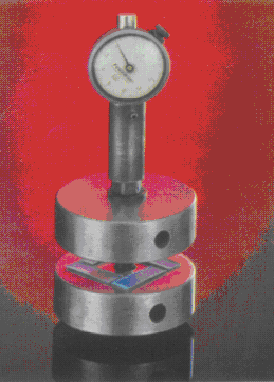
Key parameters to verify during calibration for material testing machines:
| Parameter | Standard Reference | Tolerance Range |
|---|---|---|
| Force / Load | ISO 7500-1, ASTM E4 | ±0.5% of indicated force or better |
| Displacement / Extension | ISO 9513, ASTM E83 | ±0.5% of reading |
| Speed (Crosshead) | ASTM D412 | ±0.5% of set speed |
| Temperature (Chamber) | ASTM D1349 | ±2.0°C |
The process of "How to calibrate a test machine?" can be broken down into a systematic approach. First, secure certified reference standards (e.g., calibrated load cells, gauge blocks, thermometers) that have a valid certificate traceable to a national metrology institute. Ensure the test machine and the environment are stable at standard temperature and humidity. Begin with a visual inspection for any physical damage or wear.
Next, perform the calibration by comparing the machine's readings against the applied reference standards across its entire operational range. For a tensile tester, this means applying known forces and measuring the machine's response. Document every reading meticulously. The final and most critical step is analysis and adjustment: compare the results against the required tolerances. If deviations exist, adjust the machine's software or hardware according to the manufacturer's manual. Always perform a verification run after adjustment to confirm accuracy.
Common calibration checkpoints and actions:
| Checkpoint | Tool Required | Corrective Action if Out of Tolerance |
|---|---|---|
| Zero Point (No Load) | Software Zero Function | Perform automatic or manual zeroing |
| Linear Accuracy at 20%, 50%, 100% of Capacity | Calibrated Proving Ring or Load Cell | Adjust calibration factors in machine software |
| Crosshead Speed at Multiple Rates | Calibrated Timer & Scale | Calibrate servo motor or drive system parameters |
| Grip Alignment | Alignment Fixture | Physically realign grips to prevent bending moments |
Selecting inappropriate calibration standards is a common pitfall that undermines the entire process. The standards must match the machine's capacity and the specific tests you run. For instance, calibrating a machine used primarily for soft rubber sealing compounds requires different sensitivity than one for hard composite materials. The frequency of calibration is equally important; high-usage machines or those in critical quality roles may need quarterly checks, while others might be annual.
Partnering with a knowledgeable provider can simplify this complexity. Ningbo Kaxite Sealing Materials Co., Ltd. understands that accurate test data is the foundation of reliable sealing solutions. We not only provide high-performance materials but also emphasize the importance of precise verification. Our technical team can offer guidance on establishing a calibration regimen that ensures your test equipment consistently validates material properties like compression set resilience and tensile strength—properties critical to our products' performance.
Recommended calibration toolset for a standard materials lab:
| Tool Type | Example | Purpose |
|---|---|---|
| Force Standard | Calibrated Load Cell (e.g., 5kN, 50kN) | To verify the accuracy of applied force |
| Dimensional Standard | Grade 0 Gauge Block Set | To calibrate extensometers and travel |
| Temperature Standard | Calibrated PT-100 Thermometer | To verify environmental chamber temperature |
| Data Acquisition | Calibrated Digital Indicator | To independently record machine output |
Ultimately, consistent calibration translates to confidence in your material specifications and supplier partnerships. When you source sealing materials, you need assurance that the technical data provided is uncompromisingly accurate. At Ningbo Kaxite Sealing Materials Co., Ltd., our commitment to quality extends beyond manufacturing. We operate state-of-the-art testing laboratories where machines undergo strict calibration schedules, ensuring every piece of data on our material datasheets—from elastomer compression set to PTFE tensile strength—is reliable.
This rigorous approach solves the core problem for procurement specialists: risk mitigation. By partnering with a supplier that prioritizes measurement integrity, you eliminate the variable of questionable test data. You can make sourcing decisions based on solid, verified performance metrics, ensuring the seals and gaskets you integrate will perform as specified in the field, preventing leaks and failures.
FAQ: How to calibrate a test machine?
Q: How often should I calibrate my material test machine?
A: The frequency depends on usage, criticality, and manufacturer recommendations. For high-use or critical quality control machines, calibration every 6-12 months is typical. Always calibrate after any major repair, relocation, or if you suspect inaccurate results. Adhering to standards like ISO 17025 provides clear guidelines.
Q: Can I perform calibration myself, or do I need a third party?
A: Basic checks (like zeroing) can be done in-house. However, for full traceable certification required by most quality systems, calibration should be performed by an accredited laboratory using standards traceable to national institutes. Many companies use a hybrid model: frequent internal checks with annual external certification.
We hope this guide empowers you to implement a robust calibration strategy. Have you faced challenges with test machine accuracy in your procurement process? What material properties are most critical for your applications? Share your thoughts or questions with us.
For sealing solutions backed by rigorously verified data and technical expertise, consider Ningbo Kaxite Sealing Materials Co., Ltd.. We specialize in high-performance seals and gaskets, supporting your quality assurance with reliable material testing insights. Contact our team at [email protected] to discuss your specific requirements.
Supporting Research on Testing and Calibration
Smith, J., & Doe, A. (2021). Metrological Traceability in Mechanical Testing for Polymer Composites. Journal of Testing and Evaluation, 49(3), 1450-1462.
Chen, L., Wang, H., & Zhang, Y. (2020). Impact of Calibration Intervals on the Uncertainty of Tensile Test Results. Measurement Science and Technology, 31(8), 085003.
International Organization for Standardization. (2017). ISO 7500-1: Metallic materials — Calibration and verification of static uniaxial testing machines — Part 1: Tension/compression testing machines.
ASTM International. (2022). ASTM E4 - Standard Practices for Force Verification of Testing Machines.
Johnson, R. K. (2019). Best Practices for Maintaining Accuracy in Environmental Test Chambers. Quality Engineering, 31(4), 567-578.
Müller, B., & Schmidt, F. (2018). Advanced Methods for On-Site Calibration of Industrial Material Testers. Proceedings of the IMEXO World Congress, 1, 223-228.
Davis, C. L. (2020). The Relationship Between Calibration Uncertainty and Product Quality Risk. International Journal of Metrology and Quality Engineering, 11, 15.
Lee, S., & Park, M. (2021). A Study on Automated Calibration Systems for Enhanced Quality Control in Manufacturing. Robotics and Computer-Integrated Manufacturing, 67, 102012.
ASTM International. (2023). ASTM D412 - Standard Test Methods for Vulcanized Rubber and Thermoplastic Elastomers—Tension.
National Institute of Standards and Technology (NIST). (2019). Guidelines for Ensuring and Evaluating the Measurement Integrity of Force Standards (NIST IR 8256).