Can RTJ gaskets be reused after flange disassembly? If you have just opened a high-pressure flange on a wellhead, heat exchanger, or pipeline, this question stops maintenance planning cold. A ring-type joint gasket is not a soft sheet gasket; it is a precision-machined metal ring that bites into the flange groove to create a hard metal-to-metal seal. Once the flange is unbolted, that sealing surface has already been permanently deformed. Reusing the same ring may seem like a fast way to cut turnaround costs, but it can introduce hidden leak paths, reduce gasket hardness, or leave debris embedded in the sealing face. For procurement and maintenance teams, the real issue is not just cost—it is whether a reused RTJ gasket can still hold design pressure without risking fugitive emissions, downtime, or safety incidents. This guide explains what actually happens during disassembly, how to evaluate a used RTJ ring, and when a new gasket from Ningbo Kaxite Sealing Materials Co., Ltd. is the safer long-term decision.
Contents
Pain point scenario: A maintenance crew pulls a flange on a 10,000 psi Christmas tree and assumes the solid stainless steel ring can be cleaned and reinstalled like a spiral wound gasket. The next hydrotest shows a small but persistent leak at the ring groove, and the team loses two shifts re-torquing bolts.
Solution: RTJ gaskets do not work by bulk compression. The ring geometry—either octagonal or oval—contacts the flange groove at a narrow band. During bolt-up, the softer ring metal yields slightly, fills surface imperfections, and creates a seal. Once the flange is disassembled, that conformed contact zone is already work-hardened and deformed. Even if the ring looks smooth, its ability to re-conform is reduced. Understanding this behavior is the first step before any reuse decision.
Table 1. RTJ gasket type comparison
| Parameter | Octagonal RTJ | Oval RTJ |
|---|---|---|
| Sealing contact | Narrow line contact on groove flanks | Rounded contact on groove bottom |
| Reuse potential | Low after deformation | Very low; round profile is easily flattened |
| Typical standard | API 6A, ASME B16.20 | API 6A, ASME B16.20 |
| Best for | High-pressure oil and gas flanges | Lower stress seating, older flange designs |
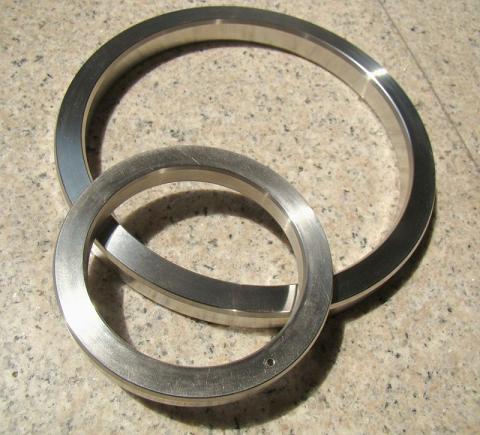
Pain point scenario: During a shutdown, a plant manager sees a stack of used RTJ rings that “look fine” and wonders if reusing them will save thousands of dollars. But the process engineer worries about fugitive emissions and a potential delayed startup if a ring fails during pressure test.
Solution: The short answer is no, for most pressure-containing joints. Industry practice and manufacturer guidance treat RTJ gaskets as single-use items because the sealing surface deforms permanently during initial seating. In a few very low-risk utility flanges—such as low-pressure water or air service below 600 psi and ambient temperature—a fitting specialist may reuse an octagonal RTJ ring after a full visual and dimensional inspection. But this is the exception, not the rule, and it should never be allowed in hydrocarbon, high-temperature, high-pressure, or toxic services. Ningbo Kaxite Sealing Materials Co., Ltd. supplies new RTJ rings with controlled hardness to ensure reliable first-time seating and eliminate the guesswork of reusing old rings.
Table 2. RTJ reuse decision matrix
| Flange class / service | Reuse condition after disassembly | Recommended action |
|---|---|---|
| 150#–300# low-pressure water/air | No visible damage; hardness within range; groove clean | Reuse only after documented inspection |
| 600#–900# steam or hydrocarbon | Surface deformation present, high leak consequence | Replace RTJ gasket |
| 1500#–2500# wellhead/API 6A | Metal-to-metal seal critical; any prior seating makes reuse unsafe | Always replace |
| Sour service / H2S | Cracking or sulfide stress risk in used ring | Always replace |
Pain point scenario: A procurement buyer is asked to approve reuse of old RTJ rings after a flange disassembly, but the maintenance report only says “rings removed.” There is no record of flange facing condition, no hardness test, and no torque values. The buyer cannot assess risk.
Solution: Before making any reuse call, evaluate five factors: material hardness match, flange groove condition, previous service exposure, gasket geometry, and documented bolt load. The old RTJ ring may be harder than the groove, which risks indenting the flange; if it is too soft, it may have extruded. Temperature cycling can create microcracks. Documentation is essential. Without a full traceability record, the only safe choice is replacement. Kaxite supplies RTJ gaskets with material certificates and hardness values that simplify this risk evaluation for new installations.
Table 3. Reuse risk factor checklist
| Risk factor | What to check | Safe limit for reuse |
|---|---|---|
| Gasket hardness | Compare with flange groove hardness | Gasket should be softer than groove by design; no work-hardened spots |
| Surface finish | Look for radial scratches, pitting, flat bands | No visible defect; Ra within original tolerance |
| Flange groove condition | Inspect for embedded debris or scoring | Clean, smooth, no pitting |
| Service history | Review pressure, temperature, media | Low pressure, non-cyclic, non-corrosive only |
| Bolt load record | Confirm original torque and tension | Properly seated without over-torque |
Pain point scenario: An inspector picks up a used RTJ ring from a dismantled heat exchanger. The surface looks bright under shop lights, but small defects are easy to miss. Without a repeatable checklist, two inspectors may reach different conclusions.
Solution: Start by cleaning the ring with a non-metallic brush and solvent. Look along the sealing contact band with a 10x magnifier. Reject any ring with nicks, scratches, flat spots, galling, or corrosion pitting. Measure the cross-section and compare it with the original dimensions from ASME B16.20 or API 6A. Check hardness in at least three locations. If all checks pass, the gasket may be considered for low-criticality reuse only. If any check fails, replace the ring. Kaxite manufactures new RTJ rings with clearly documented dimensions and hardness so inspectors do not have to make borderline calls on used parts.
Table 4. Visual and dimensional inspection criteria
| Inspection item | Acceptance condition | Reject condition |
|---|---|---|
| Contact band | Smooth, uniform | Flat, grooved, or scratched |
| Hardness variation | Within ±10 HB of original | Outside specified range or inconsistent |
| Cross-section | Matches nominal dimensions | Any measurable loss of height or width |
| Surface defects | No pitting or cracks | Any pitting, nicks, cracks |
| Flange contact | Even seating line | Partial or uneven contact evidence |
Pain point scenario: A refinery team debates reusing a set of RTJ rings on a hot-oil line after a flange disassembly. The rings were used for five years at 650°F and are now stained but not cracked. The cost to replace is modest, but the risk of a fire or lost production is not.
Solution: In any service where leakage can cause fire, toxic exposure, environmental release, or unplanned shutdown, replace RTJ gaskets after disassembly without exception. The same applies to high-pressure gas, steam, thermal cycling, vibration, and flanges requiring ASME PSM or API 6A compliance. A new ring costs much less than a failed hydrotest or a safety incident. Ningbo Kaxite Sealing Materials Co., Ltd. keeps standard RTJ ring sizes and materials in stock to reduce replacement lead time and help maintenance teams avoid the temptation to reuse questionable gaskets.
Table 5. Service conditions requiring a new RTJ gasket
| Condition | Reason to replace | Example application |
|---|---|---|
| High pressure (>900#) | Sealing margin is too small for reused rings | Wellhead flanges, production manifolds |
| High temperature (>400°F) | Thermal softening and oxidation affect ring | Steam lines, hot-oil circuits |
| Thermal cycling | Microcracks may form in used ring | Hydrocracker feed lines |
| Lethal or toxic service | Leak consequence unacceptable | H2S, HF acid, chlorine |
| Flange groove damage | Used ring cannot re-seat on damaged groove | Any corroded or scored flange |
Pain point scenario: You need to replace several RTJ gaskets after flange disassembly, but local stock is incomplete, material certificates are missing, and the delivery quote is weeks out. The maintenance window is closing.
Solution: Ningbo Kaxite Sealing Materials Co., Ltd. manufactures RTJ ring joint gaskets in standard and custom sizes, with materials from soft iron and low-carbon steel to 304/316 stainless steel, duplex, Inconel, and Monel. Every batch can be supplied with EN 10204 3.1 material certificates, hardness test reports, and dimensional inspection records. This documentation helps you verify that a new gasket is correctly matched to the flange groove, avoiding the failure risks of reusing old rings. Kaxite also provides technical guidance on ASME B16.20 and API 6A dimensions, ring types, and hardness selection.
Table 6. Kaxite RTJ gasket specifications
| Parameter | Available range |
|---|---|
| Standard | ASME B16.20, API 6A, EN 12560 |
| Ring type | Octagonal (R, RX, BX), oval |
| Material | Soft iron, LCS, SS304, SS316, Duplex, Inconel 625/825, Monel |
| Size range | R11 through R105; custom sizes on request |
| Hardness | Per standard or customer specification, with test reports |
| Documentation | Material certificates, hardness reports, dimensional records |
Q1: Can RTJ gaskets be reused after flange disassembly if the flange faces are free of visible scratches?
A: Even if the flange faces look clean, the old RTJ ring has already plastically deformed to fill the groove. In low-pressure, non-hazardous utility service below 600 psi and ambient temperature, some maintenance teams may reuse an octagonal ring after cleaning, dimensional checks, and hardness verification. However, any visible contact band flattening, work hardening, or loss of surface finish means the gasket will not re-seat uniformly. For ASME B16.20 and API 6A pressure joints, replacement is strongly recommended. Ningbo Kaxite Sealing Materials Co., Ltd. can help confirm whether a used ring is suitable for reuse in your specific non-hazardous low-pressure application.
Q2: What are the main risks of reusing RTJ gaskets after flange disassembly in high-temperature service?
A: High-temperature service introduces thermal cycling, oxidation, creep, and material softening. A reused ring may have work-hardened zones or microscopic cracks that are not visible to the naked eye. When the flange is re-torqued, the old ring cannot conform evenly to the groove, causing uneven bolt load, loss of seating stress, and a potential leak path. The safe practice is to replace high-temperature RTJ gaskets with new hardness-matched rings. Kaxite supplies heat-resistant RTJ gaskets in stainless steels and nickel alloys for temperatures up to the material limit of the ring and flange.
Every flange disassembly is a chance to reset the sealing system the right way. If your team is still asking “Can RTJ gaskets be reused after flange disassembly?” or you need a fast replacement ring that matches your flange specification, contact the sealing specialists at Ningbo Kaxite Sealing Materials Co., Ltd. We supply API 6A/ASME B16.20 ring joint gaskets, spiral wound gaskets, and custom metal seals for oil and gas, petrochemical, and power generation. Our engineers can guide you through material selection, hardness verification, and reuse risk assessment. Visit https://www.kaxiteseal.cn or email [email protected] to request a quotation or technical datasheet.
1. Hsu, K.H., 2019. Plastic deformation behavior of octagonal ring joint gaskets for high-pressure flanges. Journal of Pressure Vessel Technology, 141(2).
2. Nelson, T.W., 2017. Leak tightness of metal ring joints after repeated assembly. International Journal of Pressure Vessels and Piping, 152.
3. Zhao, Y., and Chen, L., 2020. Hardness matching effects on sealing performance of RTJ gaskets in subsea flanges. Engineering Failure Analysis, 116.
4. Omiya, Y., 2016. Experimental evaluation of contact stress distribution in ring joint gaskets. ASME Pressure Vessels and Piping Conference, PVP2016-63124.
5. Kim, J.H., 2018. Effect of surface roughness on metal-to-metal seal performance of ring joint gaskets. Tribology International, 124.
6. Patel, R.S., 2021. Reuse assessment of metallic gaskets for bolted flange connections in refinery service. Journal of Loss Prevention in the Process Industries, 69.
7. Brown, A.J., 2015. Corrosion and work hardening of soft iron RTJ rings after service exposure. Materials Performance, 54(7).
8. Lee, S.B., 2019. Finite element analysis of oval and octagonal ring joint gaskets under non-uniform bolt loads. Journal of Mechanical Science and Technology, 33(9).
9. Miyazaki, K., 2020. Tightening characteristics of RX and BX ring joint gaskets for API 6A flanges. Journal of High Pressure Technology, 34(2).
10. Davis, M.E., 2022. Reliability of reusing API 6A ring joint gaskets after wellhead disassembly. SPE Drilling & Completion, 37(1).
-